Traditional Chinese Medicine (T.C.M.) has been in existence for many thousands of years.
Acupuncture was gradually developed in the last 4 to 6 thousand years, predominantly in China, Tibet and Northern India. No one knows the exact origin of acupuncture but it appears likely that the originators wished to find a way of combining a physical and 'energy' approach to the correction of human disease.
The Chinese based their working philosophy of Taoism on the concept of YIN-YANG the opposites within the perfect whole. The symbol on the cover of this leaflet shows how within the circle they eternally flow into one another.
The principle of acupuncture is that by inserting a terminal, e.g. a needle, an adjustment can be made to the energy potential of the acupuncture point. These points are known to act in several spheres at once.
- Acu-points work on the bio electrical field energy, the life force the Chinese call CHI. Recent investigation shows that when examined by a scanner, acu-points emit 'photons' - particles of light. The physical energy of life force so deeply appreciated by the ancients, can be seen as 'real' in the western scientific sense, the acupuncture meridian system is really a stream of light particles flowing in the electro-magnetic field of the body.
- They work on the nervous system.
- They affect the circulation of blood and fluids.
The adjustment of a point then has a domino effect on the system, causing a catalytic action to take place. Thus we stimulate the point Colon 4 and this will increase the amount of activity in the colon, and also stimulates the resistance of the body to disease.
Acupuncture is capable of regulating dysfunction and correcting the onset of disease providing gross pathology has not become established. However even in the case, for example of gross arthritic change, it is possible to provide assistance and easing of the condition, whilst not necessarily being able to reverse it.
The best way to regard acupuncture is to see it as a balancer, a stimulation and a tuning mechanism, in a way a comparison would be to that of a poorly tuned car engine always giving trouble. After tuning the performance is greatly increased. Thus with acupuncture a way of balance to restore the harmony of good health. To the musician, a drawing together of notes to make a chord of energy. I think one could say, in its present form, that if your mind and body are the instrument on which you play the music of life, the acupuncturist is your "tuner".
The acute condition and pre-clinical state can usually be resolved with acupuncture. The Chinese use it to treat successfully many conditions, from acute bronchitis, pneumonia, back strain, through to the more common degenerative disorders like arthritis. The treatment can be summarised as the use of stimulation to acu-points, to set in motion the body's ability to heal itself.
The diagnosis of T.C.M. is based on the concept of the eight principles, both in Herbalism and Acupuncture. The eight principles were mentioned in the ancient classics of Chinese medicine as a complete diagnostic and treatment system. The whole body of Chinese medicine is a complete system, not just a 'bolt-on' technique to augment other medical practice.
The Five Elements
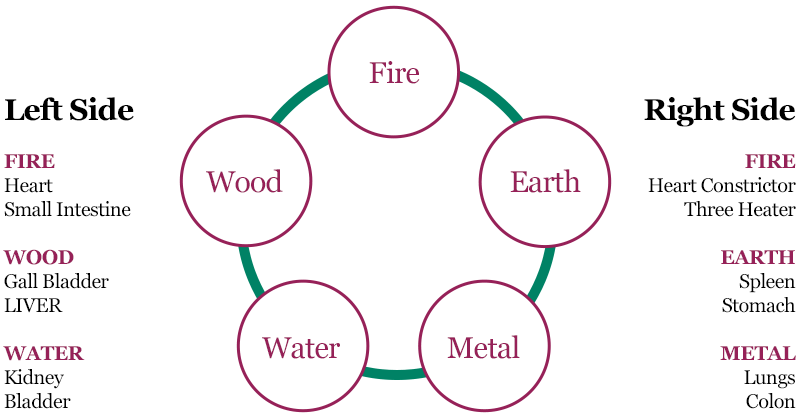
When China was closed to the West, until the 1970's, our knowledge of the real traditional Chinese medicine was limited to one of their diagnostic techniques, the concept of the five elements. The five elements, as the diagram shows, is designed as a concept of matching natural elements to organs, seasons and function. The Chinese use it as part of their diagnostic techniques.
In Europe when acupuncture came to be used 20-40 years ago much propagated by the French Doctor Jules Lavier, the five elements and the use of points related to elements assessed by the Chinese 'pulses', was all we had. This system was very good at balancing the body-mind, but often very time consuming or ineffective at correcting physical problems.
This diagram shows the flow of energy from one 'element to another, the nurturing or 'shen' cycle, with its controlling counterpart, the 'ko' cycle e.g. metal controls wood by cutting it, fire controls metal by melting it. The five elements concept is a pictorial way of describing an endless flow of nurturing and controlling energies.
The Chinese being very pragmatic, use only what works, they say, deal with the acute problem, e.g. frozen shoulder, or spinal pain, then balance the system. It is completely erroneous to imagine that continually "balancing" the system alone will eventually correct all problems, both areas need to be dealt with.
The organs listed on the left and right sides correlate to 3 positions held over the radial artery at the wrist. The rate, flow, strength and character of the pulse in each of the three sectors, at two depths of pressure, give 12 separate items of information, which correspond to the 12 primary organs and channels or Meridians of acupuncture. The pulse helps us to determine the state of an organ as regards its function.
The basic eight principles approach, coupled to the five elements, with a thorough understanding of the concept of Yin-Yang, is essential to the acupuncturist. He analyses the history of the patient, specific problem areas, the pulses, the condition of the tongue, the modalities (what makes worse, what better etc.), facial diagnosis, typology, blood tests, x-rays etc. The information obtained is then fed into the analysis according to the principles of T.C.M.
The Eight Principles
Li (Internal)
Piao (External)
These classifications indicate the site and extent of disease.
Han (Cold)
Je (Hot)
Denotes the nature of disease.
Hsu (Empty)
Shih (Full) Differentiate extent of seriousness of disease and the body level of resistance.
Yin - the primary base - negative.
Yang - positive
The synopsis of treatment in Chinese medicine is as follows:
Analysis
Question
Listen
Palpate
Observe
Scent
Processing
5 elements
8 principles
Tongue
Facial diagnosis
Type of discharge
Treatment
Acupuncture
Herbs
Exercises
Massage
Moxibustion
The Orientals pay great regard to the condition of parts e.g. tongue, face etc. before arriving at an analysis of the problem and a treatment regime.
The Oriental perception is much more to let the system unfold and demonstrate its story rather than immediately to go 'digging in' as we do in the West. I was particularly interested to see this when I studied in Japan, their techniques were pragmatic and to the 'point', but their analysis was wide ranging and deep.
The Orientals believe, as a cornerstone to their philosophy, the principle of keeping systems running properly by regular 'tuning' often long after a specific problem has been dealt with, system toning once a month or once a quarter when the seasons change, is regarded as being very beneficial. I have followed this philosophy for many years and can see in the people I do this for a positive benefit in their health and well being.
New Techniques
Electro-Acupuncture developed in the 1930's as a means of stimulating acu-points to save on time and manual-needing. I feel that this technique is good for 'gross' situations e.g. analgesia for surgery or treating intractable or post-operative pain and I use it for such, but I feel it has little to do with the subtle flow of life energy.
Laser Acupuncture - use of Helium - neon/Gallum-Arsenide lasers to trigger acupuncture points, particularly useful for treating children and ear points. Laser can also be used for speeding wound healing and ulcers etc. particularly useful in sports injuries.
Treatment of addictions - the popular treatments for anti-smoking, alcoholism and food cravings are all based on the principle of using ear acu-points which link to the nervous system and directly to the appetite centre of the brain. The treatment causes a gentle balancing of the chemistry which governs the body's 'perception' of need for stimulants.
The Holistic concept is to endeavour, where possible, to intercept the course of disease before it becomes irrevocable, and stimulate the system to take corrective action.
Detailed questions can be answered as regards specific conditions by qualified practitioners. Be sure to check on a practitioner to make sure he is registered with the national controlling body. No properly qualified person will mind this. Also, be sure to check that your potential practitioner is properly qualified to practice acupuncture, as a few short courses exist to give basic training to people qualified in other fields of medicine, which gives them about as much grasp of acupuncture as an acupuncturist would have of brain surgery!
Acupuncture is a great meeting ground for the energies of two people through the medium of a set of needles. A great opportunity to receive balance and enhancement of health. I look forward to sharing this with you and being of service with this most ancient of healing arts.